 العربية


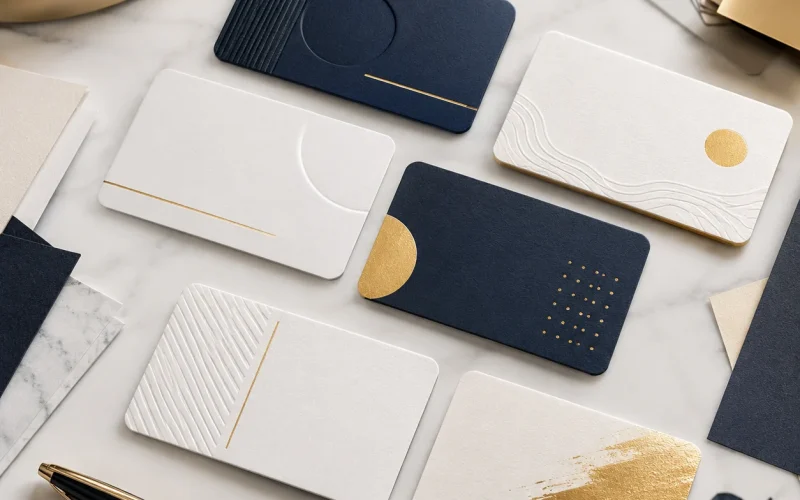
In a crowded market full of competitors and advertising messages, the small card is no longer just a way to write a name and phone number. It has become a marketing tool capable of opening conversations and building trust from the very first moment. When a customer receives a carefully designed card, they do not only see contact details; they form an impression of your professionalism, taste, and attention to detail. That is why designing business cards creatively can turn a passing meeting into a real opportunity for cooperation and purchase.
Why Are Business Cards Still Important in Modern Marketing?

Some may believe that digital transformation has reduced the importance of printed materials, but reality proves otherwise. A paper card gives communication a tangible dimension that a link or quick message cannot easily provide. When you hand over your card in a meeting, exhibition, workshop, or field visit, you leave a physical impression that stays with the customer after the meeting ends.
Business cards also give the brand an opportunity to appear in a brief and focused way. Instead of explaining everything verbally, the design can speak for you: a calm color that suggests trust, a clear logo that reinforces identity, premium material that reflects quality, and a short phrase that encourages the customer to take the next step.
| Design Element | Its Role in Attracting the Customer | Practical Tip |
|---|---|---|
| Logo | Connects the card to the visual identity | Place it clearly without exaggeration |
| Colors | Communicate the brand’s personality | Use two or three colors at most |
| Font | Makes reading easier and reflects professionalism | Avoid decorative fonts in contact details |
| Material | Leaves a tangible impression | Choose paper that matches the value of the service |
| Call-to-action phrase | Encourages the customer to get in touch | Keep it short and direct |
1. Design a Card That Tells Your Brand Story
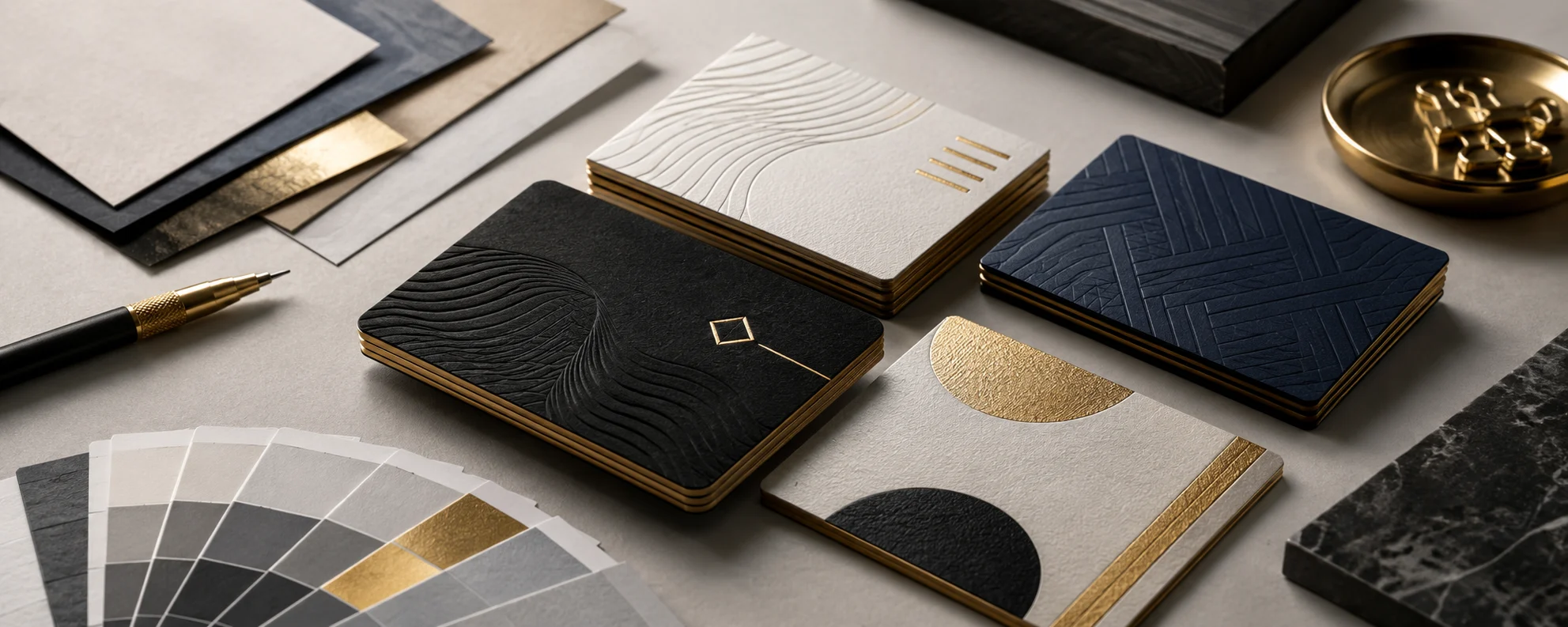
The first idea starts with a simple question: what feeling do you want the customer to have after seeing your card? If you offer a luxury service, a calm design, white space, and thick materials may be a suitable choice. If you work in a creative field, you may need bolder colors and an unconventional visual layout.
Do not make the card a miniature version of a crowded advertisement. Choose one element that represents your story: a visual symbol, geometric pattern, distinctive material, or a short sentence that expresses your promise to the customer. An engineering office can use precise lines inspired by blueprints, while a coffee shop may suit warm paper texture and a deep brown color.
2. Turn Business Cards into a Useful Experience
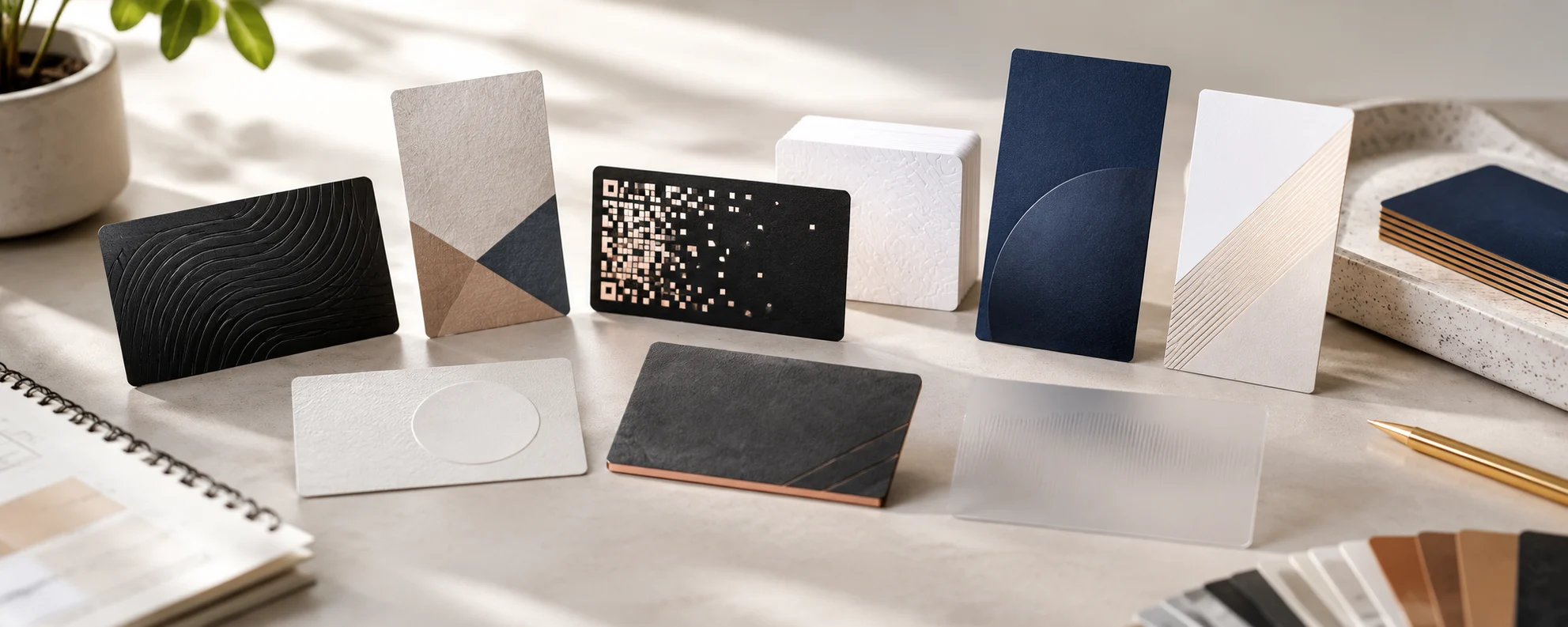
One of the best ways to make sure the card is not thrown away quickly is to give it an additional function. The card can become a discount card, appointment card, small ruler, bookmark, or compact loyalty card. When the customer finds practical value in it, they are more likely to keep it and return to it later.
This idea is suitable for clinics, beauty salons, cafés, small shops, and personal trainers. Instead of being just an introduction tool, the card becomes a continuous reminder of your service, provided that the added function remains simple and does not affect the clarity of the contact details.
| Business Type | Suggested Additional Use | Marketing Benefit |
|---|---|---|
| Dental clinic | Appointment reminder | Reduces forgotten appointments |
| Café | Mini loyalty stamp card | Encourages repeat purchases |
| Bookstore | Bookmark | Keeps the card with the customer for longer |
| Beauty salon | Discount for the next visit | Encourages return visits |
| Personal trainer | Short workout schedule | Enhances practical value |
3. Use Unconventional Materials Wisely
The material can change the impression before the customer reads a single word. Thick paper, velvet texture, embossed printing, colored edges, or partial gloss are all elements that add value when used correctly. But innovation does not always mean choosing the most expensive material; it means choosing a material that serves the message.
When designing business cards for a brand focused on sustainability, recycled paper with a natural texture can be used. Technology companies, on the other hand, may suit smooth paper with a light metallic touch. In creative fields, rounded edges can give the card a different personality without making it annoying or difficult to store.
4. Make White Space Part of the Design
White space is not wasted empty space; it is a design element that gives the eye comfort and makes important information clearer. A crowded card may look cheap even if it is printed in high quality. Therefore, include only the necessary details: name, job title, contact number, email or website, and logo.
You can use the back side smartly instead of forcing everything onto one side. The first side can focus on identity and impression, while the second side can include details or a short motivational phrase. This way, the customer feels that the design is organized and easy to read, which strengthens their trust in your organization and professionalism.
5. Choose Colors Connected to the Customer’s Emotions
Colors are not just a matter of personal taste; they are a psychological tool that affects impressions. Blue suggests trust, green is associated with growth and nature, black reflects luxury, and yellow creates a feeling of energy. Before choosing colors, ask yourself: what feeling suits my service? And which color matches my current identity?
Do not use too many colors so the card does not lose its balance. In most cases, one main color, one supporting color, and one neutral color for text or backgrounds are enough. It is also preferable to test the design in print, because colors on screen may differ from the final result.
6. Make Business Cards Vertical or Differently Shaped
Most cards come in a traditional horizontal design, which makes the vertical format a simple way to stand out without major cost. Vertical design is suitable for short names, long logos, or identities that depend on a top-to-bottom visual hierarchy. You can also use rounded corners or a light die-cut shape to make the card different while keeping it easy to carry.
However, avoid shapes that are too unusual. A card that does not fit into a wallet or card holder may annoy the customer. True distinction means being different enough to be noticed, yet practical enough to be kept.
7. Add a QR Code Elegantly
A QR code can be a link between the card and the digital world. Through it, the customer can visit your website, view your portfolio, save your details, access your location, or open a direct chat. But the common mistake is placing the code in a large size that overwhelms the design.
Place it in a clear location and leave enough space around it so it works when scanned. You should also write a short instruction next to it, such as: “Scan to view our work” or “Save contact details.” This phrase increases the likelihood of use because the customer knows exactly what they will get.
| Digital Card Uses via QR Code | Best Short Instruction | When Is It Suitable? |
|---|---|---|
| Show portfolio | View our work | For designers and contractors |
| Save contact details | Save my details | For sales and consultations |
| Open store location | Visit our location | For shops and restaurants |
| Start a chat | Contact us now | For fast services |
| Show price list | View our packages | For centers and clinics |
8. Write a Short Phrase That Sells Without Being Annoying
A short phrase can be the difference between an ordinary card and an influential one. You do not need a long or exaggerated sentence. Focus on the direct benefit you provide. Instead of “We provide the best services,” write “We design your identity to be remembered,” “Accounting solutions that simplify your day,” or “Your space is more beautiful with thoughtful details.”
Good wording in business cards should be clear, close to the customer, and free from vague promises. Do not write anything you cannot prove. A successful phrase helps the customer understand your value within seconds and gives them a logical reason to contact you later.
9. Make the Details Easy to Read and Understand
This may seem obvious, but it is one of the most common mistakes. Some designs look beautiful but fail at the most important function: delivering information. Make sure the font size is suitable, there is good contrast between text and background, and the phone number and email are clear without distracting elements.
Arrange the information according to importance. Start with the name, then the title or field, then the main contact method. Do not include five phone numbers and three social media accounts unless necessary. The fewer choices you provide, the higher the chance that the customer will take the desired action.
10. Test Business Cards Before Approving the Final Quantity
Before printing a large quantity, print a small sample and test it in real life. Hold the card in your hand, read it from a natural distance, place it beside competitors’ cards, and ask a neutral person about their first impression. This step reveals mistakes in color, font size, information layout, or material quality.
You can also test more than one version: one with a light background, another with a dark background, one with a marketing phrase, and another that is more minimal. Then choose the design that achieves a balance between beauty, clarity, and professionalism. Do not let your personal opinion be the only judge; the card is designed to convince the customer, not only to satisfy its owner.
Quick Criteria for Choosing the Best Design
| Criterion | Evaluation Question | Score from 1 to 5 |
|---|---|---|
| Clarity | Can the details be read within seconds? | |
| Distinctiveness | Does it look different from traditional cards? | |
| Consistency | Does it reflect the brand identity? | |
| Practicality | Is it easy to carry and keep? | |
| Call to Contact | Does it encourage the customer to take action? |
Use this table before final printing. If the design receives low scores in clarity or practicality, do not hesitate to adjust it even if it looks visually beautiful. Effective design is not measured only by its beauty, but by its ability to support your marketing goals.
Conclusion
Designing a successful card does not depend on decoration or high cost. It depends on understanding the customer, clarifying the message, and paying attention to the small details that make a big difference in the impression. When you choose an idea suitable for your field, balance form and function, and test the result before printing, you give your brand a smart marketing tool that works in every meeting.