 العربية


In a fast-changing world, it has become easy for marketing materials to look “outdated” within just a few months. Still, a marketing team or designer doesn’t need to chase every passing fad; what matters is understanding what moves the market, then choosing the elements that serve the brand message. In this guide, you’ll learn the key visual identity and typography characteristics of 2026, and how to apply them in practice when designing a brochure for a product or service—so it’s readable, persuasive, and realistically executable.
Why do design trends in 2026 matter to you?

There are three reasons why keeping up with changes is necessary—even for small businesses:
- Audience behavior changes: Readers expect faster clarity and easier visual scanning, especially with the density of mobile content.
- Tools evolve: AI and generative design have made experimentation faster and cheaper, raising the baseline of expected quality.
- Sustainability and cost pressure: Decisions about paper, inks, and finishes are no longer purely aesthetic—they’re tied to budget and brand perception.
The golden rule: before you copy a competitor, ask yourself whether design trends support your marketing goal—or confuse your audience. That one question alone can save you many revisions later.
Top design and print trends for 2026

The year 2026 shows a beautiful blend of digital precision and the warmth of paper texture. The following isn’t an “absolute list,” but a set of strong trends you can pick from based on what fits your brand.
1) Variable typography and flexible fonts (Variable Fonts)
Brands are increasingly using fonts that can be “stretched” or “condensed” without losing identity, helping unify the look across brochures, websites, and apps. This supports fast reading and makes text hierarchy clearer.
2) High contrast with more breathing space
Instead of crowded layouts, designers rely more on wide margins and generous spacing between paragraphs, with bold colors or rich black to emphasize the message. The result: a brochure that customers can read quickly without feeling overwhelmed.
3) Natural colors “inspired by materials”
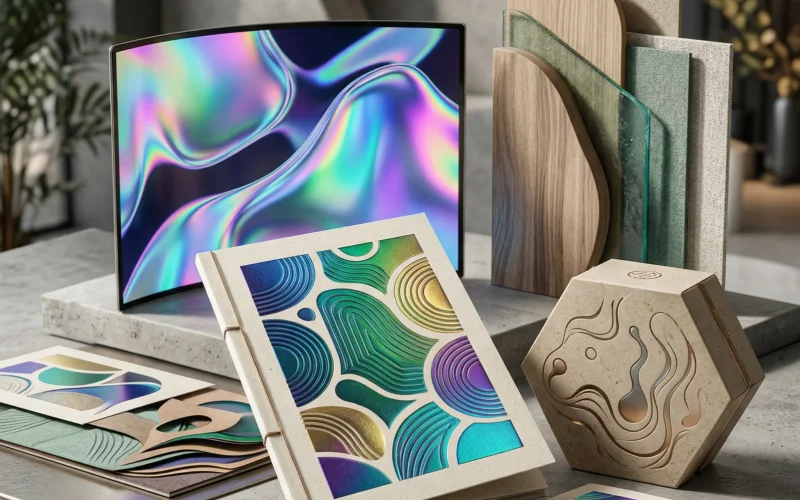
Earth, stone, linen, and non-glossy metal tones are becoming more popular. These palettes reinforce sustainability narratives and look elegant in print—especially on uncoated paper or with a matte finish.
4) Textured layers and smart finishes
Touch is back in focus: embossing, selective foiling, or fabric-like textures. The goal isn’t “luxury” alone, but memorable differentiation—especially in trust-based sectors like real estate and professional services.
5) Blending real-world print with a digital touch
QR codes aren’t new, but what’s new is using them as an experience hub: a quick order form, an image gallery, or a short product video. Print becomes a gateway to digital—not just an information sheet.
6) Clarity- and accessibility-first design
There’s increasing focus on comfortable font sizes, proper color contrast, and reducing secondary text. This helps readers with visual needs—and every busy reader.
7) “Human signature” illustrations
Even with abundant tools, there’s a growing preference for illustrations that feel hand-drawn or intentionally imperfect. This gives the brand a human tone and reduces the “everything looks the same” effect in marketing materials.
Quick trend map (data table)
| Trend | Where it appears in the brochure | Marketing benefit | Execution note |
|---|---|---|---|
| Flexible fonts | Headlines and subheadings | Clearer hierarchy | Choose a typeface with strong Arabic support (if needed) |
| Contrast & spacing | All pages | Faster reading | Don’t sacrifice core content |
| Natural colors | Backgrounds and elements | Calm, trustworthy feel | Try uncoated paper |
| Textured finishes | Cover and logo | Memorability | Use selectively |
| QR for experience | Offer / ordering page | Higher conversion | Link to measurable pages |
| Clarity & accessibility | Text and charts | Lower drop-off | Mind font size and spacing |
| Human illustrations | Icons and visuals | Human tone | Keep visual consistency |
| Story-driven layout | “Why us” page | Builds trust | Write short and direct |
Comparison of common print finishes in 2026 (data table)
| Finish | Feel / look | Best for | Approx. cost | Notes |
|---|---|---|---|---|
| Matte (Matt) | Elegant and calm | Professional services | Medium | Reduces glare |
| Gloss | Vibrant shine | Consumer products | Low–medium | May show fingerprints |
| Spot UV | Localized shine | Highlighting a logo / title | Medium–high | Effective on dark backgrounds |
| Foil (gold / silver) | Selective luxury | Gifts / real estate | High | Use on limited elements |
| Embossing | Strong tactile texture | Cards and covers | Medium–high | Needs suitable paper stock |
| Recycled paper | Natural and warm | Sustainable brands | Medium | Color may lean warmer |
| Premium cotton paper | Soft texture | Premium brands | High | Ideal for limited runs |
How to use 2026 design trends when designing a brochure for a product or service

The first step isn’t choosing colors—it’s defining one core idea you want the brochure to leave in the reader’s mind. Then you apply design trends in a way that serves that idea without unnecessary showmanship. Follow this practical sequence:
1) Define the goal precisely
Do you want a booking? A quote request? A store visit? When the goal is clear, the copy becomes shorter, the last page becomes stronger, and the call-to-action becomes obvious.
2) Understand the customer’s reading path
Most people don’t read a brochure from start to finish. They scan: strong headline → quick benefits → trust proof → contact method. Design for this path, not for your internal information order.
3) Write concise, scannable content
Break the copy into:
- A main headline that promises an outcome.
- 3–5 benefits in short bullet points.
- A “how it works / how to use” paragraph.
- Trust proof (numbers, testimonials, warranty).
- A clear call-to-action.
And to strengthen SEO at the content level (even if the brochure is printed), make the message reusable digitally: the same benefits can become a landing page or a post, creating consistency in search visibility.
4) Choose a suitable brochure structure
Common structures include:
- Tri-fold brochure: good for short messages and services.
- Bi-fold brochure: good for a single product with images (here we focus on copy rather than photos).
- Small 8-page booklet: good for service lists or a mini catalog.
5) A short practical example (service)
Suppose you’re promoting “home appliance maintenance within 24 hours.” The brochure could be structured like this:
- Cover: a clear promise + contact number.
- Inside: 4 benefits (speed, warranty, original parts, transparent pricing).
- Process section: “Book → We arrive → We fix → You rate.”
- Trust proof: number of customers, average rating, warranty duration.
- Back page: QR for booking + contact channels.
This is where design trends add value by making content feel organized: enough spacing, a clear typeface, and contrast that guides the eye to “Book now.”
A quick checklist to apply design trends without overdoing it
- Use one strong headline instead of three competing headlines.
- Choose a clear Arabic typeface for headings and a comfortable one for body text; don’t overuse font families.
- Keep benefits as short bullets and reduce long sentences.
- Create “breathing room” around the call-to-action—it’s the most important element.
- If you use a special finish, keep it to the cover or logo only.
- Make the QR code lead to a fast-loading, mobile-friendly page.
- Test readability: ask someone to grasp the idea in 10 seconds.
- Adjust based on feedback, then keep the identity consistent across channels.
Remember: the best design trends are the ones the reader doesn’t notice as “trends”—they simply feel that the message is easier to understand.
A concise action plan for producing a professional brochure (data table)
| Stage | Deliverables | Suggested duration | Success metric |
|---|---|---|---|
| Quick research | Understand audience and competitors | 1 day | List of key messages |
| Copywriting | Headlines + benefits + CTA | 1 day | Scannable text |
| Initial design | Layout and page structure | 1–2 days | Clear hierarchy |
| Language review | Proofreading and refinement | Half day | Error-free copy |
| Print prep | Margins / bleed / colors | Half day | Print-ready file |
| Test print | Single proof copy | 1 day | Excellent color and readability |
| Final print | Required quantity | Depends on the print shop | Delivered to quality standard |
How do you measure brochure success after printing?
After distribution, don’t rely only on general impressions. Collect simple signals to improve the next version: how many calls or messages came in because of the brochure? What question did customers ask most (and could it have been answered inside the brochure)? If you use a QR code, track visits and form completion rate. In stores, observe where people pick up the brochure and where they leave it—this alone reveals whether the cover is attractive enough. Finally, ask the sales team to write down one sentence they hear often; it will likely become the strongest headline for the next print run.
Frequently asked questions about design and printing
Do these trends fit all industries?
Not necessarily. Some sectors require more conservatism and clarity than innovation. Rule of thumb: start with what supports trust and readability, then add just one distinctive touch.
How do I balance cost and quality?
Choose good paper and one impactful finish instead of many finishes. Smart investment is often in the cover and headlines, because they shape the first impression.
What’s the biggest mistake in service brochures?
Too much information before showing the benefit. The customer wants: what do I gain? how? and what do I do now? Arrange your content to answer these quickly.
Conclusion
In 2026, success doesn’t depend on being “the loudest,” but on the brochure that condenses the idea and guides the reader to a clear next step. When you choose what suits you from design trends and apply it with discipline, you’ll get printed material that looks modern, works as a real sales tool, and can be easily repurposed in your digital campaigns as well.