 العربية


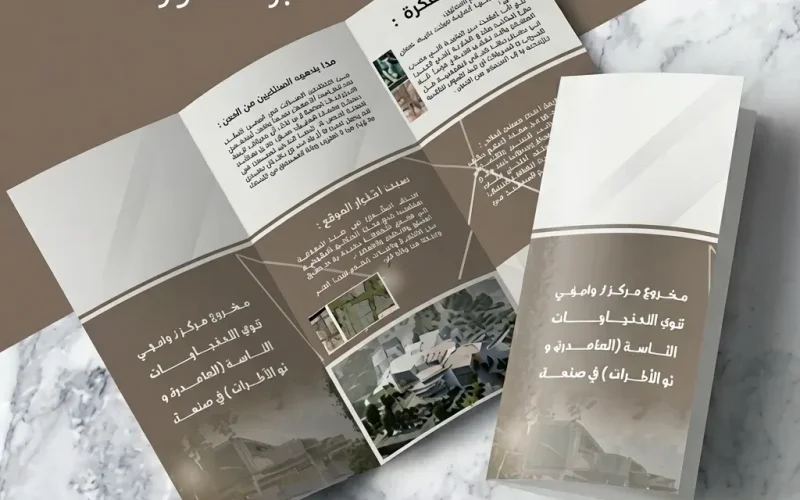
In a highly competitive Arab market, it is not enough to have an excellent product or a strong service; you need a concise marketing tool that introduces you quickly, explains your value clearly, and leaves a visual impression that encourages the customer to take action. This is where the power of brochure design appears—as a tool that combines persuasion, trust-building, and message simplification in one page (or a few pages) that can be distributed at exhibitions, offices, points of sale, or sent as a PDF via WhatsApp and email.
This article gives you a professional framework for creating a brochure that reflects your brand, with practical examples and tables that help you make precise decisions about content, layout, cost, and measurement—using a clear style that suits an Arab audience looking for results, not generic marketing talk.
Why is brochure design an indispensable marketing tool?
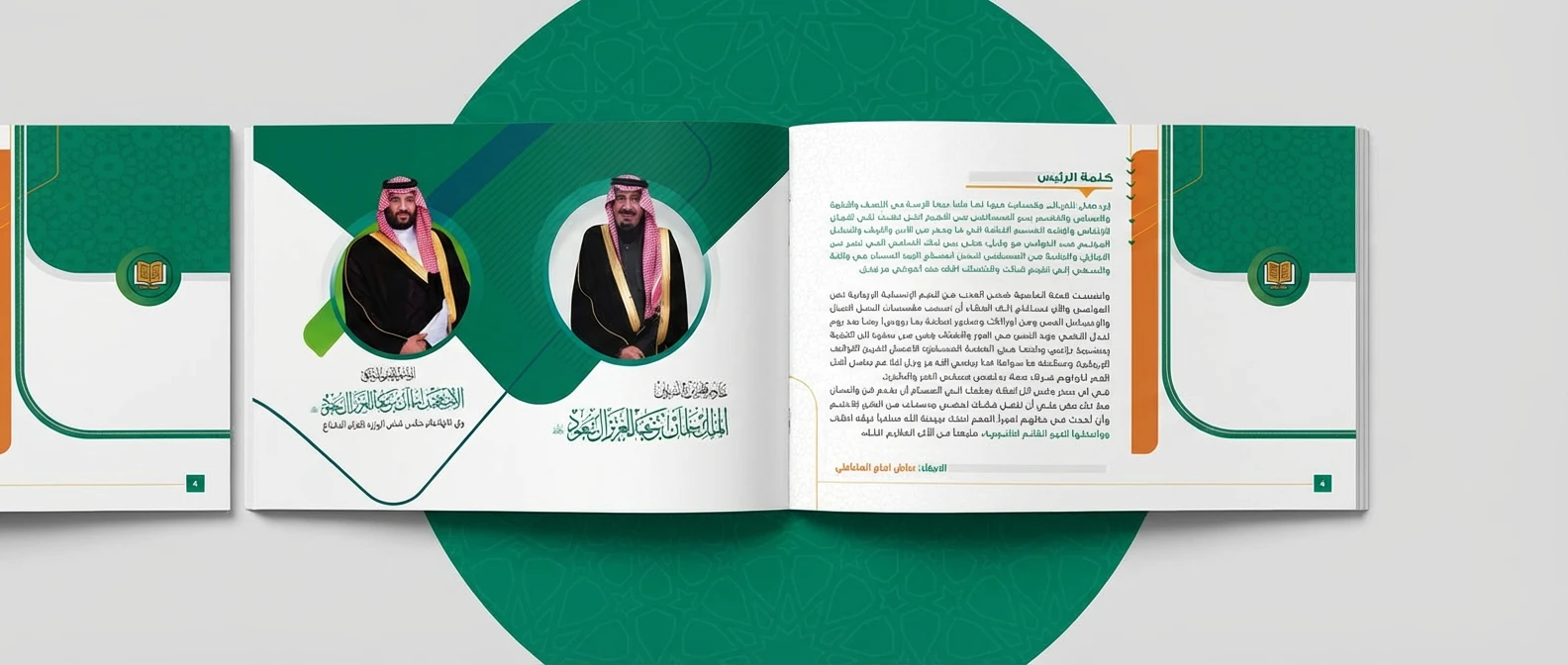
A good brochure shortens a long journey of questions for the customer. Instead of repeating the same explanation every time, a brochure provides a “standardized version” of your marketing message: Who are you? What do you offer? Why are you the best choice? And how can the customer reach you? When brochure design is executed professionally, a sheet (or a PDF file) becomes a sales representative working on your behalf all the time.
The most important advantage of a brochure compared to social media posts is that it is “owned by you” and not subject to algorithms or fluctuating reach. It is also ideal for sectors that rely on trust and considered decisions, such as medical services, tourism, real estate, consulting, training, technical services, and mid-to-high priced products.
Tangible benefits you can measure
- Strengthens first impressions and builds trust faster.
- Reduces hesitation by presenting benefits in an organized way.
- Increases inquiry volume because customers receive enough information to take the next step.
- Supports your sales team with a ready-to-share, easy file.
- Unifies visual identity and marketing language across all touchpoints.
Choosing the right brochure type based on your goal and audience
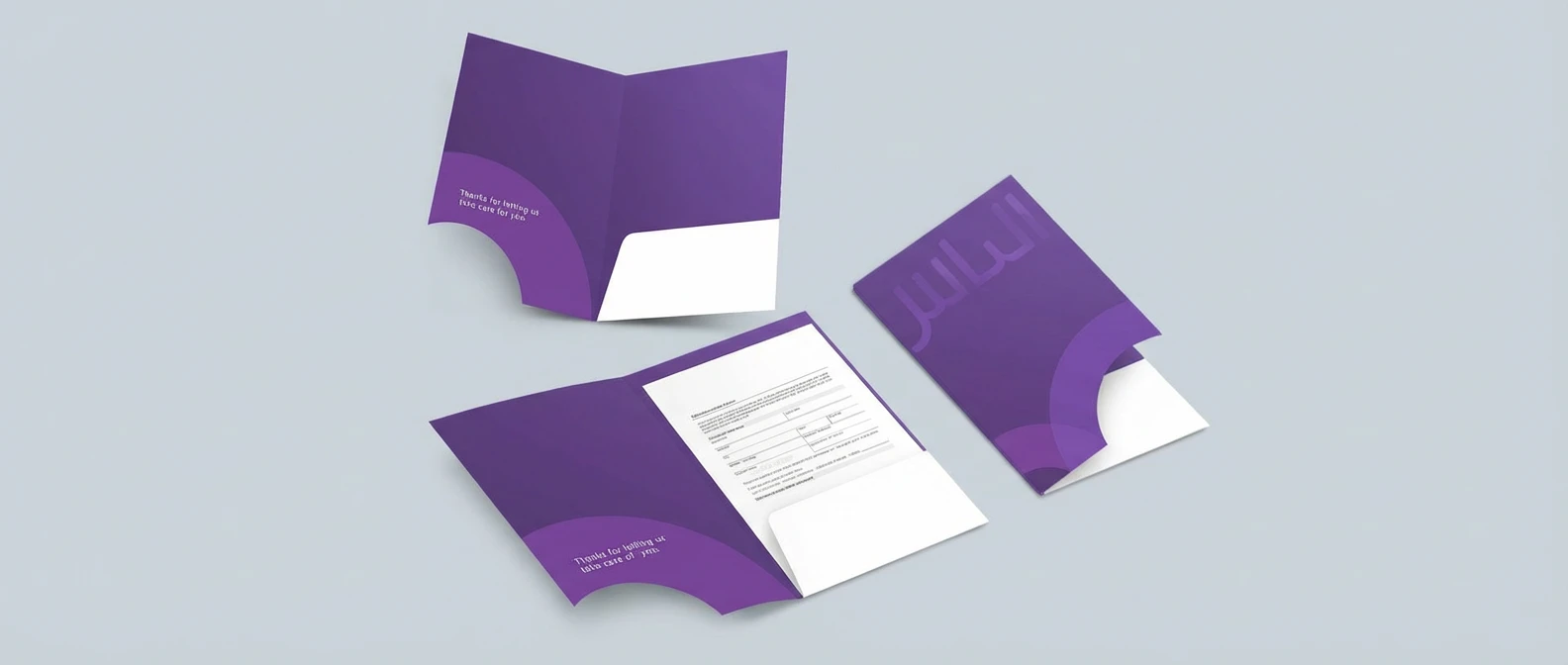
Not every brochure fits every use case. The size, number of folds, paper type, or file format should depend on distribution method, information volume, and customer behavior.
Quick comparison table of brochure types and their best uses
| Type | Best for | Key advantage | Execution note |
|---|---|---|---|
| Two-sided sheet (A4 or A5) | Quick offers, price lists, short services | Low cost and easy to distribute | Requires smart, concise copy |
| Bi-fold | Multiple services or packages | Clear sectioning | Excellent for points of sale and offices |
| Tri-fold | Service companies, tourism, training | Comfortable reading flow | Needs strong message sequencing |
| Small booklet (multiple pages) | Many products or a company profile | More room for explanation | Higher cost and needs professional editing |
| Interactive PDF | WhatsApp/email sending | Easy sharing and measurable performance | Optimize readability on mobile |
Steps to design a successful brochure—from idea to final version
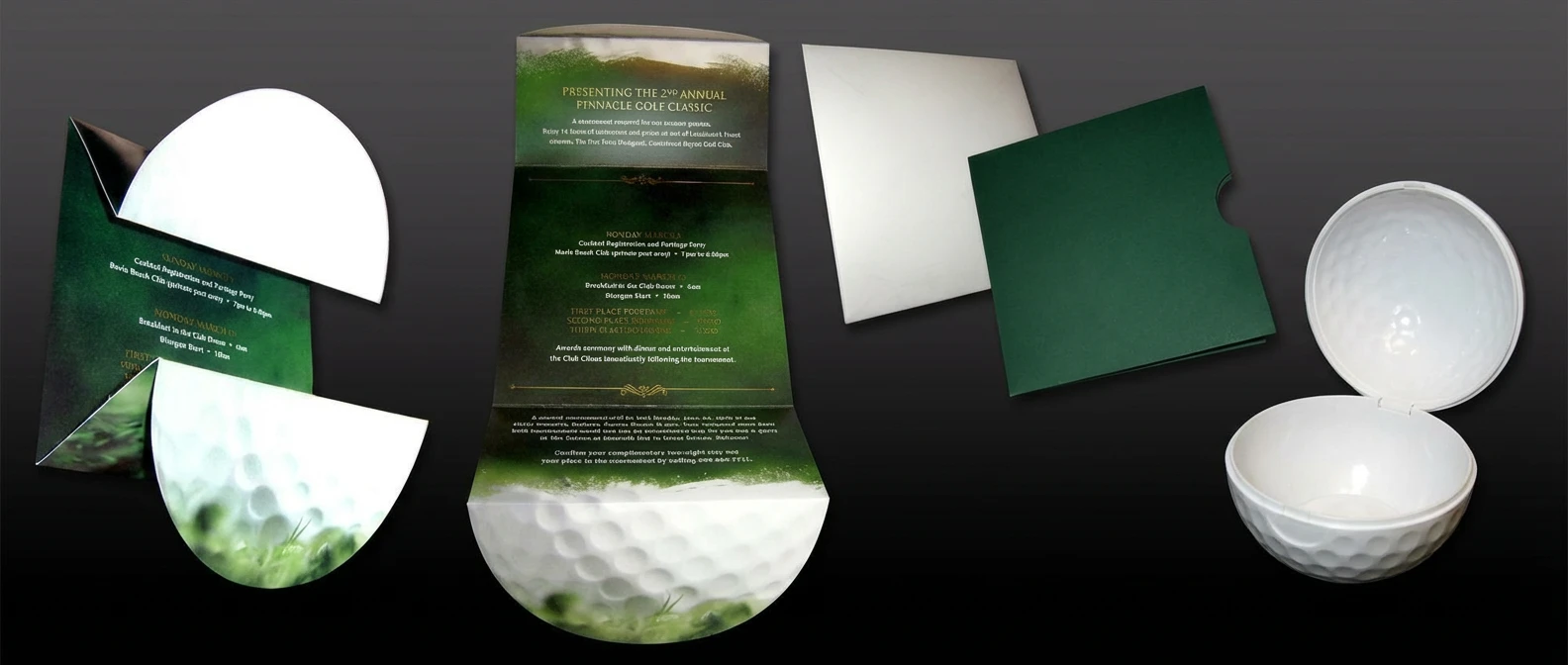
To achieve a professional result, do not rely on taste alone; follow a clear process that starts with the objective and ends with testing before printing or publishing. These steps reduce mistakes and ensure your marketing message lands as intended.
1) Define the marketing objective clearly
Before anything, ask: What action do I want the reader to take?
- Phone call?
- Website visit?
- Request a quote?
- Sign up for a service?
- Visit the branch?
Having one primary objective makes brochure design more persuasive, because the call-to-action (CTA) becomes focused rather than scattered.
2) Understand your audience: what do they truly care about?
The Arab audience is diverse: in some sectors price matters most, while in others it is warranty, speed of delivery, reputation, or reliability. Gather fast answers from:
- Frequently asked customer questions.
- Sales objections (why do they hesitate?).
- The most praised feature after purchase.
3) Prepare the content before you start designing
Design does not fix weak copy. Draft clear, concise, benefit-driven content. A brochure typically succeeds when it answers:
- What problem do you solve?
- What solution do you provide?
- Why you specifically?
- What proof do you have? (numbers/results/short testimonials)
- What is the next step?
4) Build the message architecture
Arrange information according to how customers decide:
- A strong headline that communicates the benefit.
- A short intro that defines the service/product.
- Key benefits (3–6 points).
- Trust proof (numbers, years of experience, certifications, brief ratings).
- Packages or options (if applicable).
- A clear call-to-action.
- Contact details and important links.
At this stage, you will notice that successful brochure design depends on message clarity as much as visual appeal.
Professional brochure content: what to write and what to avoid
What should you include?
- A clear value proposition in simple language.
- Features and benefits tied to tangible outcomes.
- Real differentiators (not generic slogans).
- Social proof: numbers, partners, brief testimonials.
- Contact details: phone, WhatsApp, website, address, business hours.
- One primary CTA (and a secondary CTA if needed).
What weakens a brochure?
- Long text with no structure.
- Generic headlines like “the best” without evidence.
- Visual clutter: too many colors and multiple fonts.
- Missing essentials (e.g., no phone number or URL).
- Putting everything on the same page with no hierarchy.
Quality standards in brochure design that reflect your brand identity
Quality is not just “a nice look.” It is readability, visual consistency, and a sequence that guides the eye toward the intended action. When you apply professional standards to brochure design, you will see a direct difference in customer confidence and willingness to contact you.
Key practical standards
- Visual identity: Commit to your brand colors and typography.
- Visual hierarchy: Larger headline, then bullet points, then details.
- White space: Not emptiness—an organizing tool for readability.
- Correct Arabic language: With simplified sentences and reduced complexity.
- Mobile readability if PDF: suitable font size and strong contrast.
- CTA clarity: A line or button that directs the customer: “Call now” or “Request a quote.”
Tables to help you decide practically on time, cost, and results
Estimated production time by complexity
| Complexity level | Work description | Expected duration |
|---|---|---|
| Simple | Two-sided page, ready content, one revision | 1–2 days |
| Medium | Tri-fold, partial content editing, 2–3 revisions | 3–5 days |
| Advanced | Multi-page booklet, full copywriting, two versions (print + PDF) | 7–14 days |
Performance indicators to measure after distribution
| Metric | How to measure it | Why it matters |
|---|---|---|
| Number of inquiries | Track calls/WhatsApp inquiries over a defined period | Measures message strength |
| Conversion rate | (Actual requests ÷ inquiries) | Measures audience quality and content fit |
| Cost per lead | (Printing/distribution cost ÷ number of inquiries) | Defines channel viability |
| Most attractive section | Ask customers: “What attracted you most?” | Helps improve the next version |
Checklist before printing or digital sending
Use the following checklist to reduce errors that cost real opportunities:
- Proofread headlines and copy to ensure the brochure design focuses on a clear benefit—not generic description.
- Confirm phone/WhatsApp/URL accuracy and format them to be easy to copy.
- Test quick comprehension: can a new person understand the offer within 15 seconds?
- Ensure consistent colors, typography, and spacing.
- Review spelling and punctuation.
- For print: confirm paper quality and finishing (based on your use case).
- For PDF: confirm file size and fast loading on mobile.
Marketing tips to boost brochure impact in the Arab market
- Make the headline outcome-focused: “Save time,” “Increase sales,” “Get service within 24 hours” instead of generic statements.
- Add a “guarantee/commitment” element when relevant: quality guarantee, return policy, on-time commitment.
- Reduce choices if customers hesitate: three clear packages are better than ten confusing ones.
- Connect the brochure to a simple campaign: a discount code, limited offer, or a trackable link.
- Send the PDF after every call: many customers decide after revisiting and reviewing the file.
Conclusion: when is a brochure a profitable investment?
A brochure is not a secondary piece of paper—it is the most condensed version of your business message. When you execute the content, identity, and structure correctly, it becomes a sales and communication tool that supports you both on the ground and digitally. If your goal is to increase inquiries, improve brand perception, and simplify customer decision-making, choosing design a brochure professionally will be one of the most rational marketing decisions in the short to mid term.