 العربية


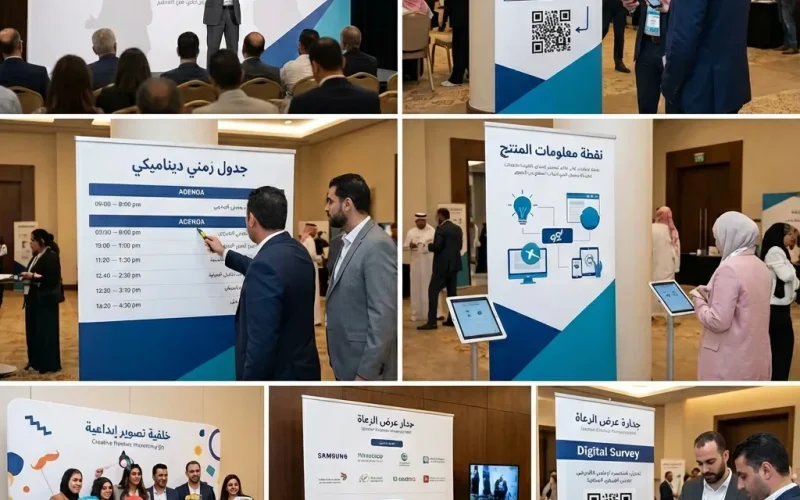
Using the Roll-up in the world of field marketing and event organization, companies race to capture visitors’ attention in a matter of seconds. Amid the visual clutter and noise at exhibitions and conferences, traditional marketing tools with direct impact remain the “Joker” that always wins the bet if used intelligently. Among these tools, the “Roll-up” stands out as one of the most effective, flexible, and economical solutions.
But have you ever asked yourself why a specific roll-up succeeds in stopping you to read it, while you pass by dozens of others without noticing them? The secret lies not only in the design but in the strategy. Using the Roll-up randomly is just “space filler,” whereas using it with a studied plan transforms a piece of cloth and plastic into a silent salesperson working for you throughout the event hours.
In this comprehensive article, we will review 7 innovative strategies to employ this tool with maximum effectiveness, supported by data tables to help you make the right decisions.
1. Strategic Location: The Art of Catching First Glances
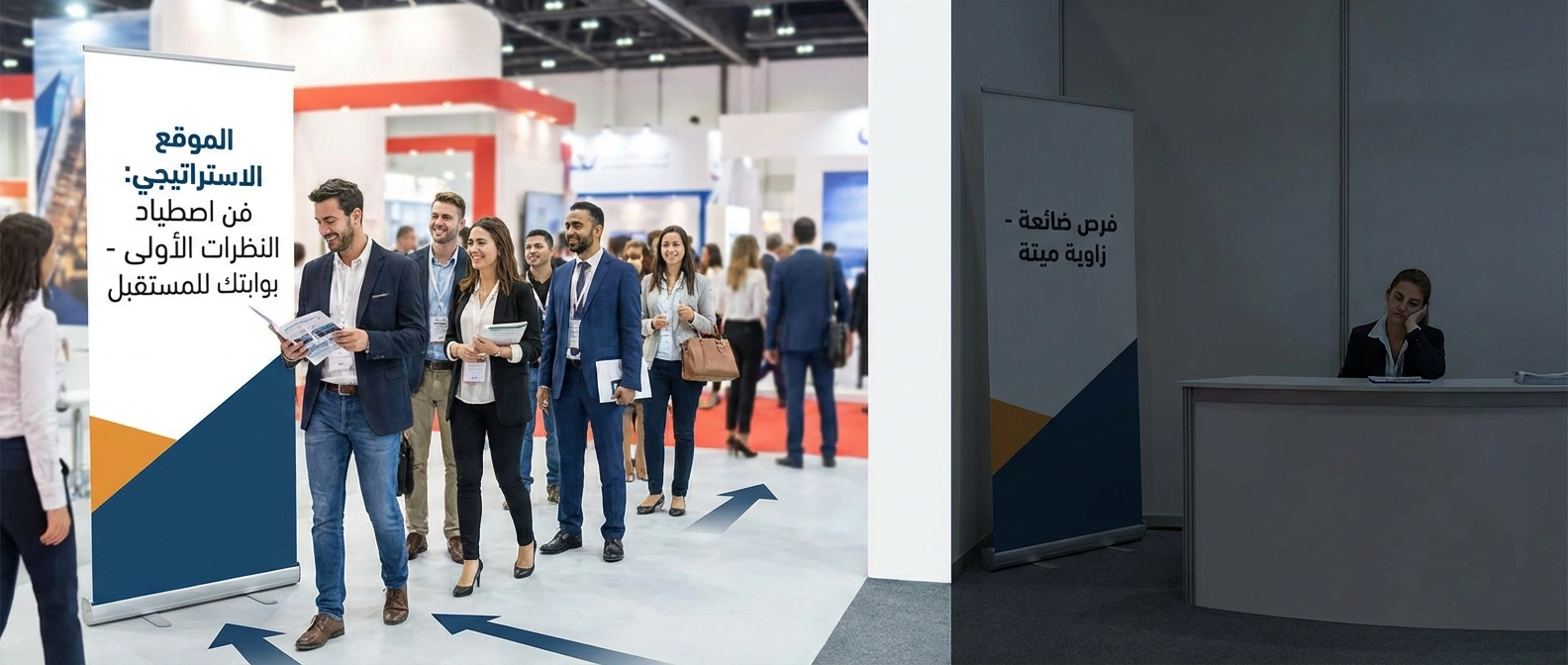
The golden rule in real estate is “Location, Location, Location,” and it applies perfectly to display tools. A common mistake is placing the roll-up behind the reception desk where employees block it, or in a dead corner that no one passes.
To maximize benefit, the roll-up must be placed in the natural flow path of visitors. The best places are the main entrances to the booth, or next to coffee and hospitality distribution points where people pause for a moment. When using the Roll-up at the entrance, it acts as a “doorman” welcoming visitors and giving them a quick idea of what to expect inside, filtering the audience and bringing in only those interested.
2. Content Hierarchy: The Three-Second Rule
A visitor passes by your stand and has about 3 seconds to decide whether to stop or keep walking. Here lies the importance of designing content with a smart visual hierarchy. The core message (Logo and Value Proposition) must be at eye level, i.e., in the top third of the roll-up.
When thinking about using the Roll-up as a photography backdrop or a booth facade, avoid placing contact information or important offers in the bottom third, as this area is often a “blind zone” or blocked by furniture or passersby’s feet. Keep the bottom part reserved for aesthetic designs or simple margins only.
3. Interactivity and Merging the Digital World (QR Codes)
The roll-up is no longer just a static banner; it has become a bridge between the physical and digital worlds. In the age of smartphones, placing a huge and clear Quick Response code (QR Code) in the middle of the design is an explicit invitation to interact.
It is smart to be using the Roll-up to announce exclusive offers that require scanning the code to obtain. Instead of printing thousands of paper flyers that might end up in the trash, let the roll-up carry a headline like “Scan the code and get a 20% discount” or “Register now for the draw.” This not only saves printing costs but also gives you real data on the number of engaged users.
4. Specificity and Focus: One Message Per Banner
Trying to say everything in one place is a magic recipe for failure. The roll-up is not a “brochure” nor a company product catalog. True effectiveness lies in specificity. If you have three main products, it is better to print three separate roll-ups, each focusing on one product with a strong message and an attractive image.
You can be using the Roll-up as a visual educational tool explaining one complex feature of your product through a simplified “infographic,” rather than stuffing text. The visitor prefers to absorb one complete idea clearly rather than reading ten scattered ideas.
5. Color Psychology and Identity Consistency
Colors are not just decoration; they are a language that speaks to the subconscious. Using bright colors like red and orange attracts quick attention and motivates a Call to Action, while blue and green suggest trust and calmness, which is suitable for medical and financial companies.
Ensure that the roll-up design harmonizes with the rest of the booth elements and the company’s visual identity. Color dissonance sends unprofessional messages. Always remember the importance of using the Roll-up to solidify visual identity; the visitor should know this stand belongs to your company even before reading the name, just through colors and visual style.
6. Quality and Materials: Impressions Last
Nothing kills a brand reputation faster than a leaning roll-up, torn edges, or faded printing. Investing in high-quality materials (such as tear-resistant polypropylene and wide bases made of durable aluminum) gives the impression that your company cares about details and quality.
To ensure success when using the Roll-up, focus on print quality and resolution (DPI). “Pixelated” images give an impression of cheapness and lack of professionalism. Always make sure the images used are high resolution and colors are set to the CMYK system dedicated to printing, not RGB which is for screens.
7. The Roll-up as a Wayfinding Tool
In large exhibitions, visitors often feel lost. You can use the roll-up as a guiding tool inside your large booth or in exhibition corridors (by agreement with organizers). Use a roll-up with clear arrows or phrases like “Start your journey here” or “Try the product over there.”
This type of usage transforms the tool from just an advertisement into a “helper” for the visitor, creating a sense of gratitude and psychological comfort towards your brand.
Technical Comparison Between Different Display Tools
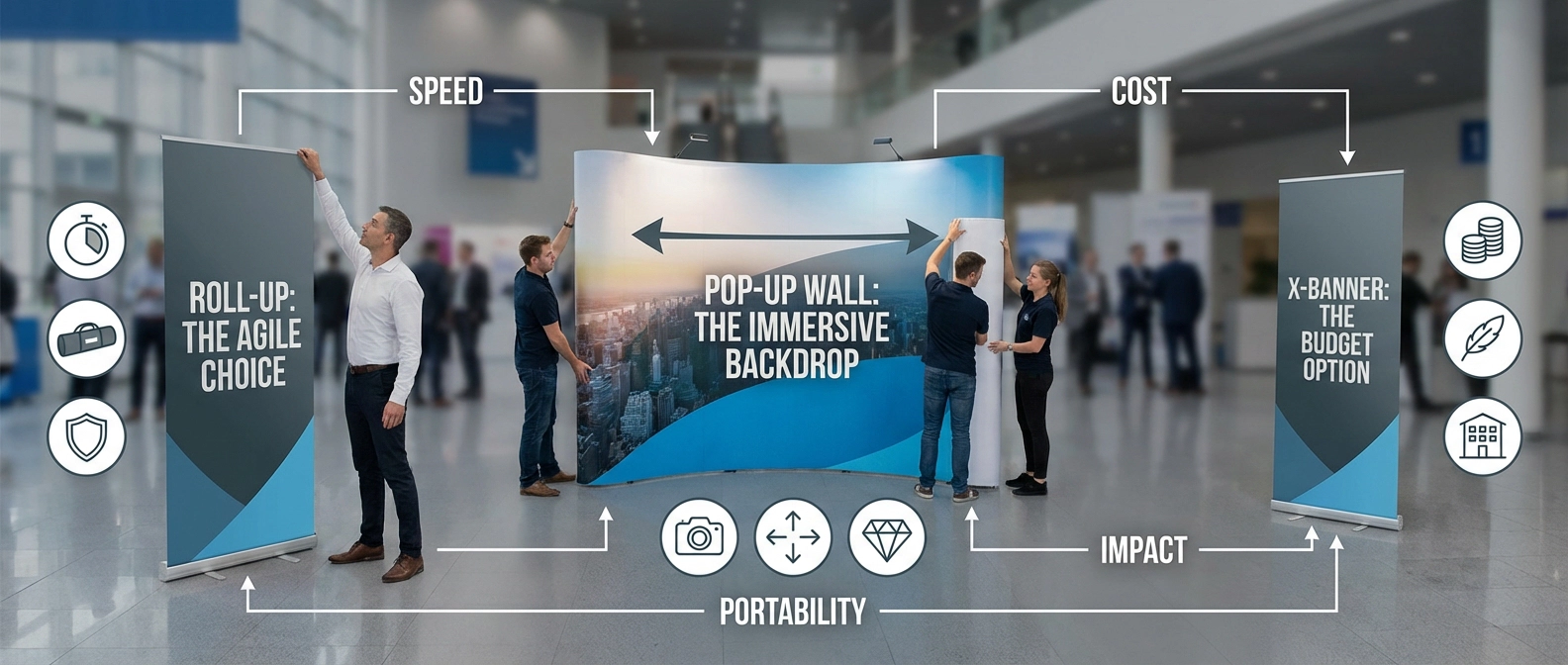
To understand why we focus on the roll-up, let’s make a quick comparison between it and other common display tools at events, to know when it is the optimal choice.
Table 1: Comparison of Event Display Tools
| Comparison Criteria | Roll-up | Pop-up Wall | X-Banner |
| Portability | Excellent (Light and comes with a bag) | Medium (Requires a large case and towing) | Very Good (Very light) |
| Setup Speed | Less than one minute | 5 – 10 minutes | 2 – 3 minutes |
| Cost | Very economical | High cost | The cheapest of all |
| Durability | High (Base protects the poster) | Very high | Low (Prone to falling) |
| Advertising Space | Vertical (Limited width) | Wall-like (Wide space) | Vertical (Limited) |
| Ideal Use | Entrances, Specific offers, Directions | Main backdrop for the stand | Quiet indoor places |
Pre-Event Checklist
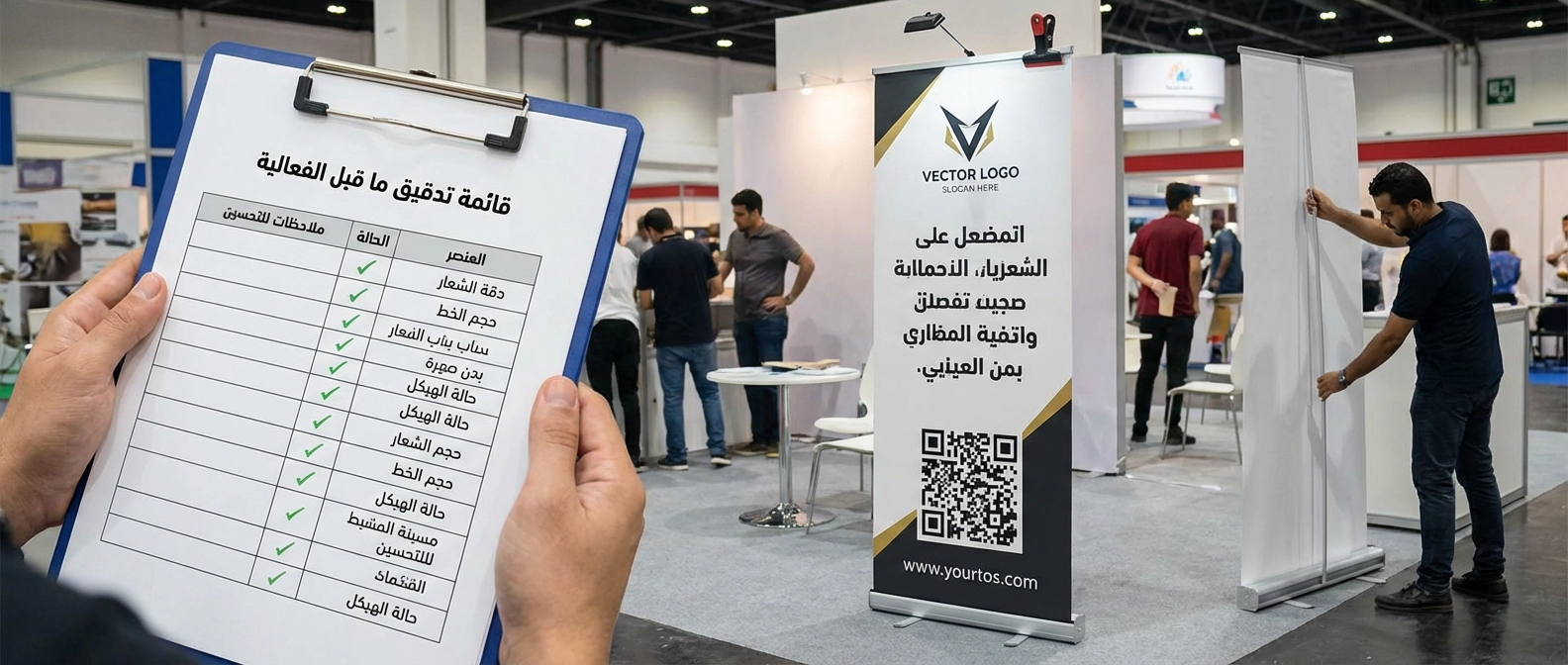
Before heading to the exhibition, make sure to review this list to avoid unpleasant surprises. Avoiding common mistakes when using the Roll-up at exhibitions is what distinguishes professionals from amateurs.
Table 2: Checklist to Ensure Roll-up Effectiveness
| Item | Status | Notes for Improvement |
| Logo Resolution | [ ] | Must be at the top of the design and in Vector resolution. |
| Font Size | [ ] | Can the main headline be read from a distance of 3 meters? |
| Colors | [ ] | Is the color contrast sufficient for comfortable reading? (Avoid yellow on white). |
| Contact Info | [ ] | Is there a clear and concise QR Code or website? |
| Structure Condition | [ ] | Check the internal “spring” and support pole before leaving. |
| Lighting | [ ] | Do you need a “spotlight” attached to the top of the roll-up? |
| Proofreading | [ ] | A single spelling error can destroy the credibility of the entire message. |
Return on Investment (ROI) and Sustainability
Given limited marketing budgets, using the Roll-up is a long-term, high-return investment. The biggest advantage of modern roll-ups is the ability to change the “message” or printed poster while keeping the same metal structure (the base). This means you pay the structure cost once, and for future events, you only pay the cost of printing the new poster.
To maintain this investment, the roll-up must be handled carefully during assembly and disassembly. When pulling the poster, do it slowly and from the center to ensure edges don’t tear. When returning it to the base, do not let it slip from your hand and slam inside; instead, guide it slowly until it settles safely in place.
Additional Tips to Enhance Psychological Impact
- Use Faces: Psychological studies confirm that the human eye is automatically drawn to images of faces and connects with them. Placing a picture of a person looking towards the written text on the roll-up involuntarily directs the reader’s gaze to read the text.
- Utilize White Space: Don’t be afraid of empty spaces. White space rests the eye and makes important elements stand out more. Crowding generates tension and drives the visitor to flee.
- Strong Headlines: Use imperative or question formats. Like “Do you want to double your profits?” or “Discover the perfect solution now.” These headlines act as hooks for the mind.
Conclusion
Success in exhibitions and conferences does not depend solely on the budget size or booth space, but largely on the intelligence of employing available tools. The roll-up, with its simple cost and high flexibility, remains an effective weapon in the professional marketer’s arsenal.
Remember that the goal is not just to fill an empty space, but to create an effective touchpoint with the potential client. By choosing the right location, smart design, focused message, and attention to quality, you can transform this vertical banner into a customer magnet.
In conclusion, mastering using the Roll-up is an art that combines sales psychology and design aesthetics, and it is a small step in preparation but can be a giant leap in the results of your participation in any upcoming event. Start now by reviewing your current designs and applying these strategies to see the difference yourself.