 العربية


When a brochure for a product or service is designed thoughtfully, it transforms from an ordinary informational sheet into a marketing tool capable of attracting attention, building trust, and motivating the customer to make a clear decision. Many Arab companies genuinely have good products, yet they fail to achieve the expected market impact because the material introducing them is weak, overcrowded, or lacks a precise marketing message.
The strength of a brochure lies in the way it combines visual persuasion, concise information, and a clear commercial message. That is what makes it suitable for exhibitions, points of sale, meetings, commercial presentations, and even digital campaigns when presented in an electronic format. Professionalism here does not come from colors alone, nor from excessive text, but from the ability of design and content to work together toward one goal: convincing the audience that this product or service is worth their attention.
Why Is the Brochure Still an Effective Sales Tool in the Arab Market?

Despite the expansion of digital marketing, concise printed and digital materials still retain their value, especially when targeting an audience that wants to understand the offer quickly. In the Arab market in particular, large segments of customers tend to trust organized materials that present benefits in a direct and clear way. Companies operating in sectors such as real estate, education, medical services, consumer products, and service-based projects still need a concise introduction tool that helps the sales team present the offer quickly and professionally.
The problem is that many designs are built on taste alone, not on reader behavior. This creates a gap between a beautiful appearance and actual results. The following article explains five essential elements that elevate the quality of the work and help you present your product or service in a more impactful way, while maintaining message clarity, ease of reading, and alignment with best practices for search engine visibility when publishing the content on a website.
1) Define the Goal and Audience Precisely Before Starting the Design
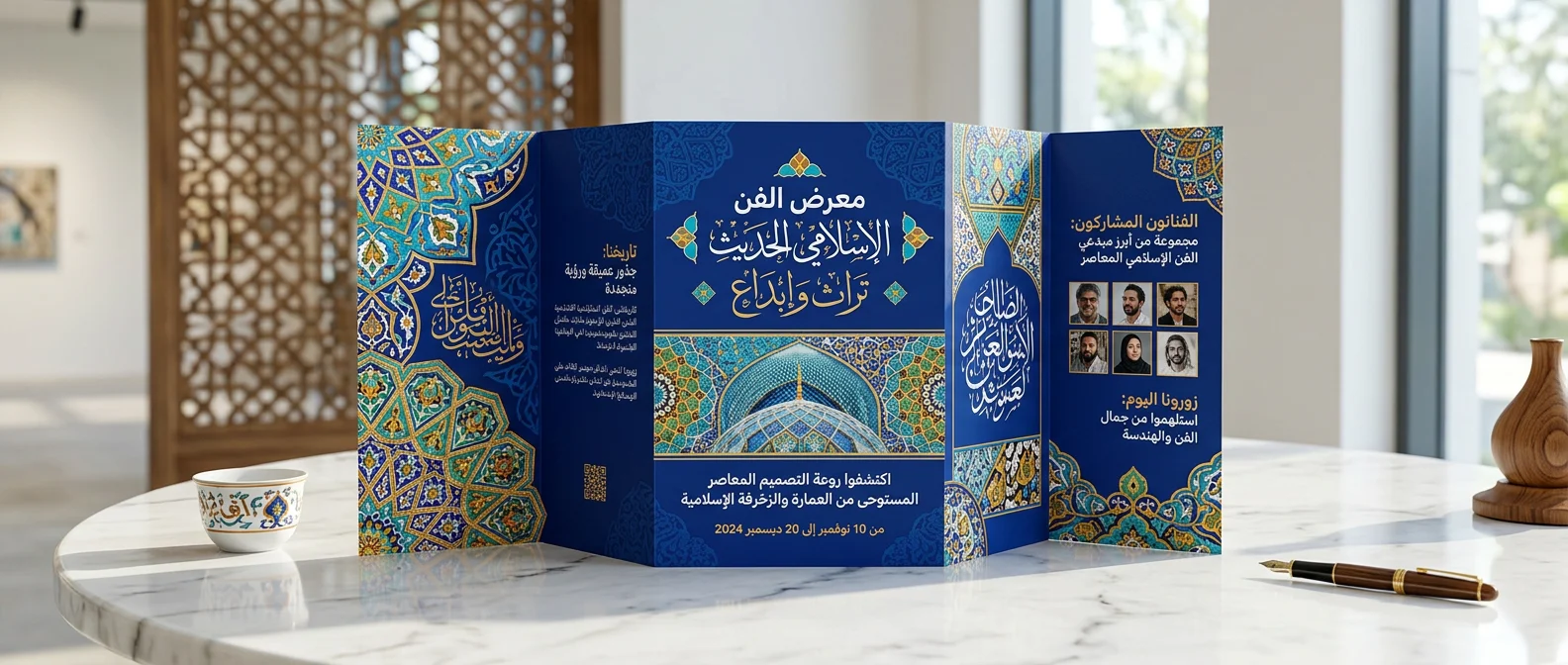
The first step in any successful marketing material is knowing its true objective. Is the purpose to introduce a new brand? To present the advantages of a specific product? Or to persuade the customer to request a consultation, a trial, or a direct purchase? Every goal requires a different presentation style, a different tone, and a different arrangement of information.
Before writing the brochure, ask yourself: who will read it? What problem are they trying to solve? And what decision do I want them to make after finishing reading? These simple questions eliminate much of the randomness. When the audience consists of business owners, the material should emphasize return on investment, efficiency, and saving time or cost. If the audience is individual consumers, the priority may be practical benefits, price, ease of use, or trust in quality.
A clear objective also determines the amount of content. Informational material for a consulting service differs from that promoting a fast-decision consumer product. The first needs to build trust and demonstrate expertise, while the second needs speed, clarity, and immediate appeal. Understanding the audience is therefore not just a preliminary step; it is the foundation on which the rest of the elements are built.
It is always better to turn audience insights into practical, actionable points, as shown in the following table:
| Element | What does it mean? | Its impact on content |
|---|---|---|
| Target segment | Companies, individuals, students, families, institutions | Determines the tone of voice and type of message |
| Level of awareness | Knows the product or does not know it | Determines how much explanation is needed |
| Purchase motive | Quality, price, speed, status, trust | Determines the main persuasion angle |
| Decision stage | Initial research or purchase intent | Determines the strength of the call to action |
| Distribution channel | Printed, WhatsApp, website, exhibition | Determines text length and presentation format |
A common mistake is turning the brochure into a space to display everything the company knows about itself, instead of making it a tool that speaks directly to the customer’s need. The customer is not primarily looking for the company’s history or the number of its branches. They want to quickly understand: what do you offer? Why are you different? And why should I choose you now?
2) A Strong Headline and a Concise Message That Explains the Value Quickly
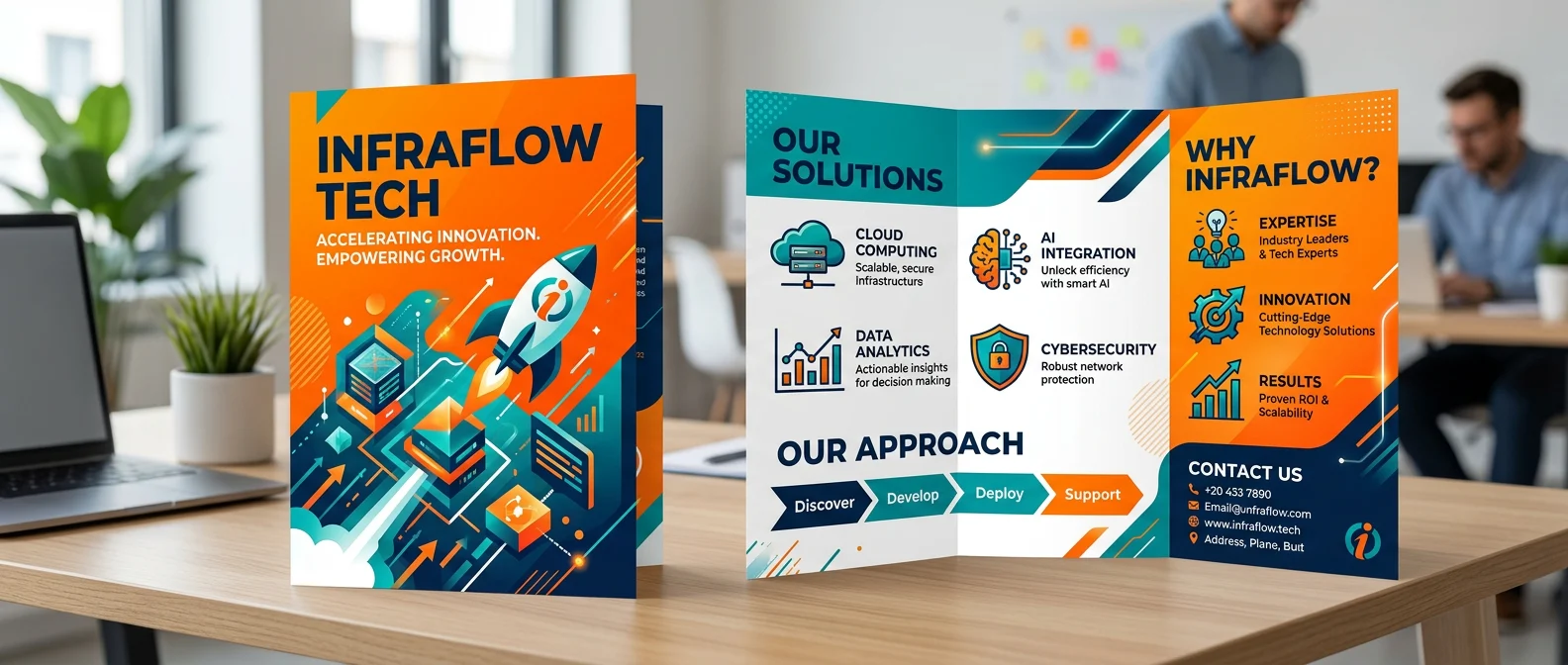
One of the main reasons any marketing content succeeds is the headline. A good headline should not merely sound nice; it must carry a clear promise or direct benefit. Instead of using generic phrases such as “the best in the market” or “premium service,” it is better for the headline to be specific and understandable from the first moment, such as “Accounting solutions that reduce reporting errors” or “A daily skincare product that provides all-day hydration.”
A successful brochure begins with a headline that captures attention, followed by a subheading that clarifies the idea, and then a short body text that supports the message without dragging on. This structure gives the reader a comfortable experience and reduces the likelihood of leaving the page before understanding the offer. It also helps when publishing the article or page on a website, since search engines prefer organized content with clear and consistent headings.
It is also important that the language be understandable to the Arab audience, far from literal translation and exaggeration. A persuasive human style does not mean using complex vocabulary. It means making the reader feel that the message was truly crafted for them. Make sure the description is direct and answers the customer’s main question: what value will I gain?
To illustrate the difference between a weak headline and an effective one, consider the following comparison:
| Headline Type | Ineffective Example | More Impactful Example |
|---|---|---|
| Generic headline | The best services ever | Professional cleaning solutions that save time and maintain quality |
| Vague headline | The quality you deserve | A natural food product with trusted ingredients and balanced taste |
| Long headline | We offer a wide range of services that meet your various needs | Fast maintenance services that reduce downtime and increase operational efficiency |
| Headline with no clear benefit | Discover excellence with us | A training program that develops your team’s skills in a short time |
The headline is not just a visual element; it is the main entry point to the content. If it fails in the first few seconds, the rest of the effort becomes less effective no matter how beautiful the design may be.
3) Organize the Content Visually and Linguistically So It Is Easy to Absorb
True professionalism appears when the reader feels that everything is in its place. The headline is clear, the paragraphs are short, the white space is comfortable, the important points stand out, and the reading flow feels natural. Text overcrowding is one of the most common mistakes that weakens content impact, because it makes the reader feel tired before they even begin.
That is why the message should be divided into logical parts: a brief introduction, a presentation of the problem or need, an explanation of the solution, highlighting the benefits, and then a call to action. This arrangement serves not only the design, but also persuasion. The mind responds better to content that can be followed easily.
At this stage, it is helpful to use concise lists when needed, especially if you are presenting product benefits or the steps for making use of a service. Best practices include:
- Start with the most important information, not the least important.
- Use short sentences that carry a single meaning.
- Focus on benefits, not specifications alone.
- Make each section lead smoothly to the next one.
- Give the eye room to rest through proper spacing between elements.
It is also important to note that visual organization cannot be separated from linguistic organization. Overcrowded language can ruin even the most beautiful design, and the opposite is also true. For that reason, it is preferable to write the content clearly first, then arrange it within the design, rather than forcing text later into unsuitable spaces.
4) Highlight Real Benefits Instead of Merely Listing Specifications
One recurring mistake in marketing materials is focusing only on technical details without explaining what they mean for the user. The customer does not buy a “specification”; they buy a “result.” They do not only want to know that the material is made with a certain technology; they want to understand how it will provide comfort, quality, save time, or save money.
So when presenting any product or service, try to turn every feature into a tangible benefit. Instead of saying the product is “lightweight,” say it is “easy to carry and use every day.” Instead of saying the service “relies on a tracking system,” explain that it “reduces delays and gives the customer clearer visibility into results.”
In the end, the brochure should lead the reader to a clear picture of the benefit they will receive, not just a memorized list of features. The stronger the connection between the feature and the outcome, the greater the likelihood of persuasion. It is even better to support this with examples, short testimonials, or real numbers when available. General statements are quickly forgotten, but a specific benefit stays in the mind.
From a marketing perspective, the message can be arranged using this simple formula:
- What problem is the customer facing?
- How does the product or service solve it?
- What result will they gain?
- Why is this solution better than the alternatives?
This method makes the content closer to actual buying logic and prevents it from falling into the trap of unhelpful self-display.
5) A Clear Call to Action and Measuring Results After Publication
The goal of any marketing material is not only to be read, but to drive a practical next step. That step could be calling, visiting the website, requesting a quote, signing up, going to a branch, scanning an access code, or contacting the company through WhatsApp. That is why the content should not end without clear direction.
The call to action should be specific and direct. Phrases like “Contact us today,” “Request your offer now,” “Book your consultation,” or “Discover the details through our team” are effective when placed in a clear position and written in a way that does not leave the reader hesitant about the next step. It is also preferable for the chosen contact methods to be few and clear, because having too many may confuse the user instead of helping them.
The performance of a brochure can be measured through practical indicators that help improve the next version. Among the most important indicators are the number of inquiries generated by it, the conversion rate, how long readers engage with the digital version, which sections attract the most attention, and how clear the offer is to the target audience.
| Measurement Indicator | What does it reveal? | How does it help you? |
|---|---|---|
| Number of inquiries | The actual level of interest | Shows the strength of the initial message |
| Conversion rate | How many took action after reading | Determines the effectiveness of the call to action |
| Engagement rate | Time spent, reading, or downloads | Shows the quality of organization and attractiveness of the presentation |
| Frequently asked questions | Unclear points | Helps improve the next version |
| Traffic source | Where the audience came from | Connects the content to the most suitable channel |
When measurement is done regularly, improvement becomes much easier. Instead of relying on personal impressions, the organization moves toward decisions based on real data, which raises marketing efficiency and increases the return on effort and budget.